
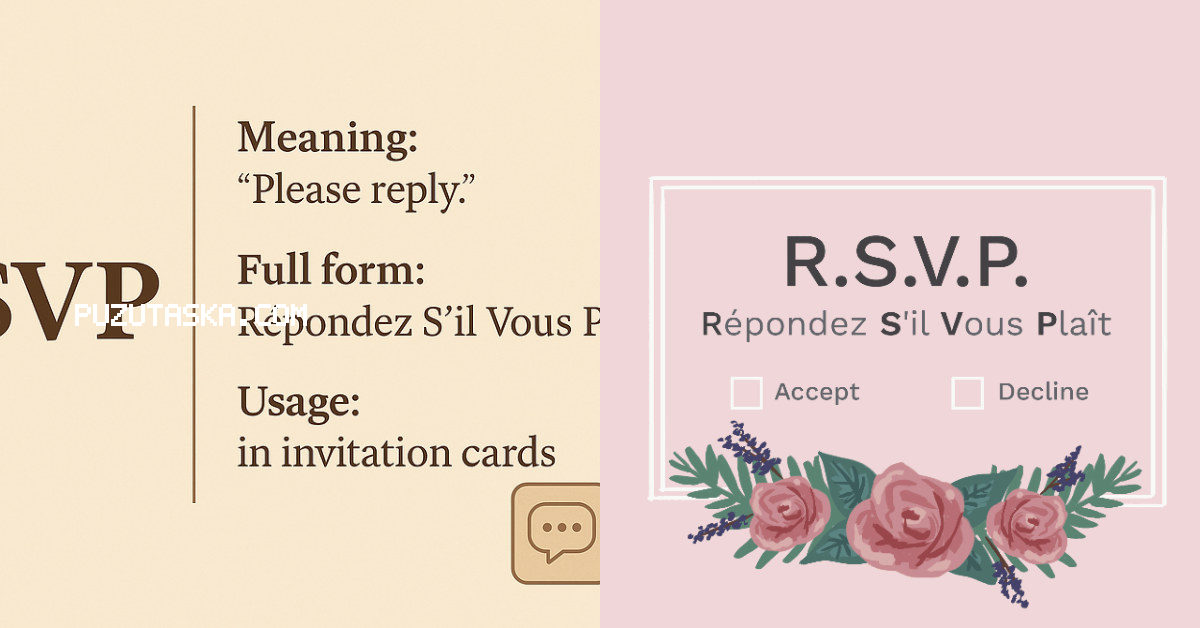
RSVP is a polite request, not a suggestion.
Most people recognize the four letters on wedding invitations or party cards, yet few trace them back to mid-19th-century French formal etiquette. That history explains why the phrase still carries a certain weight today.
What a Missed RSVP Taught a Wedding Planner About Guest Counts
In 2018, a wedding planner in Ohio shared a cautionary tale about a couple who ignored RSVP deadlines. The couple assumed the rest would simply show up.
They did not. The venue ran out of meals, and the couple faced a bill for uneaten plates. The planner’s advice, repeated in event forums, was blunt: an RSVP is a commitment, not a guess. For a complementary read on the same theme, see DesignMode24.com: What We Know About the Unverified Domain
That incident illustrates a broader truth. A single unreturned card can ripple through the entire event budget.
According to some sources, the average wedding sees a response rate below 80 percent without reminders. The more useful approach is to set a clear deadline and follow up politely with anyone who has not replied.
How a French Court Phrase Became a Global Invitation Standard
The phrase “Répondez s’il vous plaît” emerged in French aristocratic circles, where formal invitations required a written reply. By the mid-1800s, English speakers had adopted the abbreviation, keeping the French spelling even as they pronounced it as letters.
British English typically drops the periods, writing “RSVP,” while American English often retains them as “R.S.V.P.” That small typographic difference reflects how the term settled into two distinct English traditions.
The etiquette carried over too. Traditional responses mirror the invitation’s formality, using third person for very formal events. A guest might write, “Mr. and Mrs. Smith accept with pleasure,” rather than a casual “Yes, we’ll be there.”
That formality has softened over time, but the core expectation remains. Responding promptly is still seen as a basic courtesy, and missing a deadline is widely considered rude.
Why “Regrets Only” and Other RSVP Variations Confuse Guests
“Regrets only” is a different system entirely. It asks guests to respond only if they cannot attend, which shifts the burden from the guest to the host. That approach works for large events where most invitees are expected to come.
Standard RSVP, by contrast, requires a response from everyone. The distinction matters because hosts using “regrets only” assume silence means attendance, which can lead to overestimation if guests forget to reply.
Another common misunderstanding involves the verb form. People say “to RSVP” or “RSVPing” without issue, but the phrase itself already means “please reply.” Saying “please RSVP” is technically redundant, though it has become accepted in casual usage.
Digital services have added new layers. Evite, Paperless Post, and Google Forms now manage many responses online, and post-2020 trends include QR codes and email links that send guests directly to a digital RSVP page. A reference profile of the subject is maintained on Discover the meaning of **RSVP**, its **full****form**, usage, and importance in invitations, events, and formal communication.
Why Ignoring an RSVP Deadline Frustrates Hosts and Planners
The real-world impact of a missed RSVP extends beyond weddings. Corporate events, conferences, and dinner parties all depend on accurate headcounts for catering, seating, and materials.
Hosts often send reminders as the deadline approaches, and some resort to phone calls. That follow-up work adds hours to event planning, which is why many organizers now use digital tools that track responses automatically.
Cultural norms vary, but the underlying principle is consistent. An RSVP is a promise to attend or decline, and breaking that promise without notice wastes resources and creates awkward gaps at the table.
Some argue that the rise of online invitations has made RSVPing easier, yet response rates have not dramatically improved. The weaker claim here is that technology alone solves the problem; in practice, clear communication and gentle reminders still do the heavy lifting.
Frequently Asked Questions
How many letters are in the full RSVP phrase?
The full French phrase “Répondez s’il vous plaît” contains 24 letters when counting spaces and punctuation. The abbreviation itself uses four letters, which is why it appears so compactly on invitations.
Is RSVP free to use on digital invitation platforms?
Most digital invitation services offer free tiers with basic RSVP tracking, while premium features like custom domains or advanced guest management come at a cost. Evite and Google Forms both provide free options that cover standard needs.
How can I politely remind guests who forgot to RSVP?
Send a friendly message a few days after the deadline, saying something like “We hope you can join us—please let us know by Friday.” Avoid sounding accusatory, and offer a direct link to the RSVP page if you used a digital service.
Is it rude to attend an event without RSVPing?
Yes, attending without RSVPing is generally considered rude because it prevents hosts from planning accurately. If you must attend unannounced, contact the host beforehand to ask if space is still available.
What is the difference between RSVP and “regrets only”?
With “regrets only,” silence is interpreted as a yes, which can lead to overestimation if guests forget to reply.
