
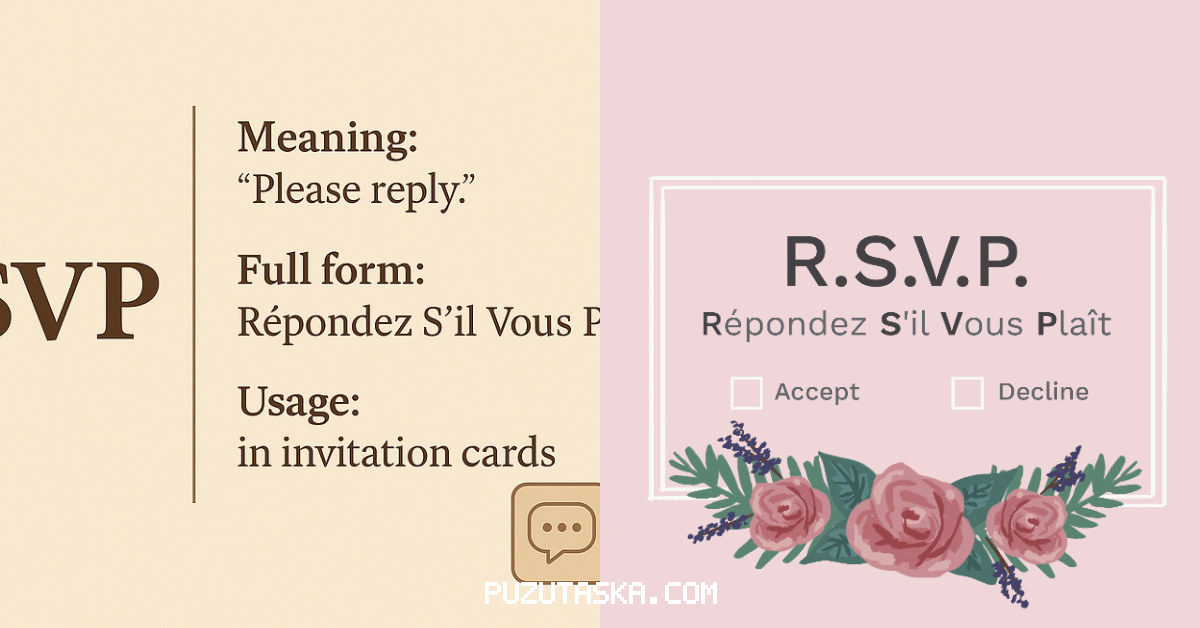
The truth is more specific. RSVP stands for the French phrase Répondez s’il vous plaît, which translates to “please reply.” It appears on invitations to signal that a response is expected, not optional.
The abbreviation has been in use since at least the 19th century, appearing in English-language etiquette manuals of the era. Yet many hosts still struggle to get guests to respond. Understanding the full form helps clarify why the request exists and how to handle it properly.
Why RSVP Carries Legal Weight in Formal Invitations
In some contexts, RSVP is more than a courtesy. For events with seating arrangements, catering orders, or security protocols, the response determines logistics. A missing reply can mean an empty chair or an overcrowded room.
Legal disputes over RSVPs are rare but real. Wedding contracts with venues often include headcount clauses. If a couple confirms 150 guests and only 120 show up, they may still pay for 150 meals. The reverse — extra guests arriving unannounced — can breach venue capacity limits and fire safety rules.
Corporate events face similar constraints. Conferences with badge printing and meal selection rely on accurate counts. Some organizers now include a deadline in the invitation wording, such as “RSVP by March 1.” That date is not arbitrary; it aligns with vendor cutoff times.
One notable case involved a charity gala in London where 40 guests failed to RSVP but attended anyway. The venue charged the organizer for the extra meals, leading to a public dispute over who bore the cost. The lesson: treat RSVP as a binding commitment, not a suggestion.
From French Courts to Modern Invitations: A Brief History
The phrase Répondez s’il vous plaît emerged in French aristocratic circles during the 18th century. Hosts of lavish balls and dinners needed accurate counts for their kitchens and staff. A written reply was a mark of respect.
English speakers adopted the abbreviation RSVP in the 1800s. Etiquette books of the Victorian era, such as those by Emily Post in the 1920s, cemented its use in formal correspondence. Post’s guides insisted that guests reply within a week of receiving an invitation. On a related note, cilxarhu677 Moisturizer Product: A Search for a Name That Does Not Exist adds helpful background
The digital age changed the mechanics but not the meaning. Online invitation platforms like Paperless Post and Evite include RSVP buttons that track responses automatically. Yet the underlying request remains identical to the handwritten notes of two centuries ago.
Interestingly, in France itself, the abbreviation is rarely used. French invitations typically say Réponse attendue or simply request a call. The RSVP convention is largely an Anglo-American import, a linguistic fossil preserved in etiquette guides.
Practical RSVP Etiquette for Hosts and Guests
If you are hosting, make the request clear. Write “RSVP by [date]” and include a phone number or email. For weddings, add a separate line for meal choices if needed. Avoid vague phrasing like “Kindly respond” without a deadline.
Guests should reply as soon as possible. A good rule is within two days of receiving the invitation, or by the stated deadline. If your plans change after you RSVP, inform the host immediately — even if it means a phone call.
When you receive an invitation with “Regrets only,” the rules flip. You only respond if you cannot attend. This format is common for casual events where the host expects most guests to come. Misreading it leads to awkward gaps.
For digital invitations, use the provided RSVP tool. Do not reply by text if the host asked for email. And never assume that a lack of response means “no” — silence is not a valid RSVP.
One practical tip: if you are a host and guests miss the deadline, send a gentle reminder. A short message like “Just checking in — we need your RSVP by Friday for the caterer” works better than silent frustration.
What Etiquette Experts Say About Modern RSVP Practices
Lizzie Post, great-granddaughter of Emily Post and co-host of the Awesome Etiquette podcast, notes that RSVP rules have relaxed but not disappeared. “The core expectation remains: respond promptly and honestly,” she said in a 2023 interview. “What changed is the medium.”
Post observes that younger guests often treat online RSVPs as low-stakes. They click “maybe” or ignore the request entirely. Her advice to hosts: follow up personally with non-responders, especially for events with per-person costs.
Event planner David Tutera, known for celebrity weddings, emphasizes the business side. “A headcount is a contract,” he told Brides magazine. “When guests don’t RSVP, I have to chase them. That costs time and money.”
The weaker claim here is that RSVP is outdated. In reality, the practice adapts. Some hosts now use WhatsApp polls or Instagram stories to gather responses. The format shifts, but the need for a clear answer remains constant.
Experts agree on one point: the best RSVP is a definitive one. “Maybe” is not a response. If you are unsure, decline and let the host know you might attend later if space allows.
| Term | Meaning | Usage |
|---|---|---|
| RSVP | Répondez s’il vous plaît (please reply) | Formal invitations |
| Regrets only | Reply only if you cannot attend | Casual events |
| RSVP by date | Deadline for response | Weddings, corporate events |
| Digital RSVP | Online response via platform | Modern invitations |
Frequently Asked Questions
Who is responsible for sending RSVP reminders?
The host or event organizer typically sends reminders. For weddings, the couple or their wedding planner handles it. A polite nudge a week before the deadline is standard practice.
Is RSVP still used in digital invitations?
Yes, digital invitations almost always include an RSVP feature. Platforms like Paperless Post and Evite track responses automatically, but the guest still must click the button. The etiquette remains the same.
How can I politely decline an invitation after RSVPing yes?
Contact the host directly, apologize, and explain briefly. Do it as early as possible. If the event has a per-person cost, offer to cover your meal if the host cannot get a refund.
Is it acceptable to RSVP with a plus-one without being offered one?
No, it is not acceptable. The invitation specifies the number of guests. Adding an uninvited person is a breach of etiquette and can cause logistical problems. If you need a plus-one, ask the host before responding.
Why did RSVP become a standard on English invitations?
English-speaking societies adopted the French phrase in the 19th century as a mark of sophistication. Etiquette writers like Emily Post popularized it, and it stuck. The abbreviation is now a global convention, even in non-English-speaking countries.
