
Popcorn Ceiling vs Textured Ceiling When choosing a ceiling finish, homeowners often encounter two terms that can sound interchangeable: popcorn ceiling and textured ceiling. They are related, but they are not exactly the same thing. In fact, a popcorn ceiling is one specific type of textured ceiling, while “textured ceiling” can describe several different finishes.
Understanding the difference between popcorn ceiling vs textured ceiling can make it easier to decide whether to keep an existing finish, repair it, repaint it, or replace it with another style. The right choice depends on factors such as appearance, maintenance, age of the home, repair needs, budget, and personal preference.
A ceiling may seem like a minor design element, but its texture can significantly affect how a room looks and how easy the surface is to maintain. Here is what homeowners should know before making a decision.
What Is a Popcorn Ceiling?
A popcorn ceiling is a heavily textured ceiling finish characterized by small bumps that resemble popcorn, cottage cheese, or a rough spray-on surface. The texture became especially popular in American homes during the mid-20th century.
The material was commonly sprayed onto drywall or plaster ceilings to create a distinctive appearance. One reason it became popular was its ability to hide minor imperfections in the underlying ceiling.
Popcorn texture also changes the way light interacts with a ceiling. Instead of reflecting light evenly like a smooth surface, the raised texture creates shadows and visual variation.
Although many older homes still have popcorn ceilings, the style has become less popular in modern interior design. Many homeowners now prefer smooth ceilings or subtler textures.
What Is a Textured Ceiling?
A textured ceiling is a broader category that includes any ceiling with a deliberately uneven or patterned surface.
There are numerous types of ceiling textures, including knockdown, orange peel, skip trowel, swirl, and popcorn. Some are subtle, while others create a dramatic pattern.
For example, an orange-peel texture has a relatively fine, irregular appearance. Knockdown texture generally has a more flattened pattern, while skip-trowel finishes can create a handcrafted look.
Because of this, comparing popcorn ceiling vs textured ceiling is technically a comparison between one specific texture and the larger category it belongs to.
Common Types of Textured Ceilings
Homeowners may encounter several ceiling texture styles.
Popcorn texture has prominent, rounded bumps and is usually one of the most recognizable finishes.
Orange peel texture creates a fine, slightly rough surface that resembles the skin of an orange.
Knockdown texture starts with a sprayed or applied texture that is partially flattened with a tool, producing a less pronounced pattern.
Skip trowel texture is created with a drywall finishing tool and often has an irregular, handcrafted appearance.
Swirl texture uses curved or circular patterns to create a decorative effect.
Each style creates a different visual result, so “textured ceiling” alone does not tell you exactly what a ceiling will look like.
Popcorn Ceiling vs Textured Ceiling: Key Differences
The biggest distinction is simple: popcorn is a type of ceiling texture, while textured ceiling is a general category.
However, there are practical differences homeowners should consider.
| Feature | Popcorn Ceiling | Other Textured Ceilings |
|---|---|---|
| Appearance | Heavy, bumpy texture | Varies from subtle to pronounced |
| Design style | Often associated with older homes | Available in traditional and modern styles |
| Cleaning | Can be difficult | Depends on the texture |
| Repairs | Can be noticeable | Depends on the pattern |
| Painting | More challenging | Usually easier with suitable techniques |
| Removal | Can be labor-intensive | Depends on texture type |
| Imperfection coverage | Excellent | Generally good |
| Design flexibility | Limited | Many available patterns |
The most important point is that not every textured ceiling has the same maintenance or removal requirements.
Which Ceiling Looks More Modern?
In many contemporary homes, subtle textures or smooth ceilings are preferred over traditional popcorn finishes.
Popcorn ceilings can make a room feel dated because of their association with older construction styles. That does not necessarily mean they are unattractive. In the right home, an existing popcorn finish can still work well with the overall interior.
A subtle knockdown or skip-trowel texture may provide visual interest without creating the highly pronounced appearance associated with popcorn.
Ultimately, “modern” is a design preference rather than a technical property. A homeowner should consider the entire room, including wall finishes, flooring, lighting, trim, and architectural style.
Is a Textured Ceiling Easier to Maintain?
Maintenance depends heavily on the specific texture.
Smooth ceilings are generally easiest to dust Popcorn Ceiling vs Textured Ceiling and wipe because there are fewer raised areas where dirt can collect. Highly textured surfaces can be more difficult to clean without damaging the finish.
Popcorn ceilings can be particularly challenging because the raised material can catch dust and may be fragile. Aggressive scrubbing or repeated contact can loosen portions of the texture.
For routine maintenance, gentle dusting is generally safer than heavy scrubbing. Homeowners should also follow the recommendations appropriate for their specific ceiling material.
Which Is Easier to Repair?
Small ceiling repairs can be complicated when the surrounding surface has a distinctive texture.
With a smooth ceiling, drywall compound can often be sanded and painted to blend a repaired area into the surrounding surface.
Textured ceilings require matching the existing pattern. This can be difficult because even a small difference in texture can make a patch visible under certain lighting.
Popcorn ceilings present a particular challenge because the repaired section needs to replicate the existing raised texture.
For older ceilings, homeowners should also consider whether the material needs to be professionally evaluated before disturbing it.
Can You Paint a Popcorn Ceiling?
Yes, popcorn ceilings can generally be painted, but the process requires more care than painting a smooth ceiling.
The texture can absorb paint differently across its uneven surface. A roller may work for some applications, but the nap and technique need to be appropriate for the texture. Excessive pressure can damage fragile popcorn material.
Spraying may provide more uniform coverage in some situations, although preparation and overspray protection become especially important.
Before painting an older popcorn ceiling, it is important to determine whether the existing material is safe to disturb.
Can You Paint a Textured Ceiling?
Most textured ceilings can be painted, provided Popcorn Ceiling vs Textured Ceiling the existing surface is stable and suitable for painting.
The specific approach depends on the texture. A fine texture may be relatively straightforward, while a heavy or fragile texture can require more careful preparation.
Before applying paint, homeowners should inspect the ceiling for peeling, cracks, water damage, loose material, or previous repairs.
Painting over a damaged ceiling without addressing the underlying problem can make future repairs more difficult.
What About Popcorn Ceiling Removal?
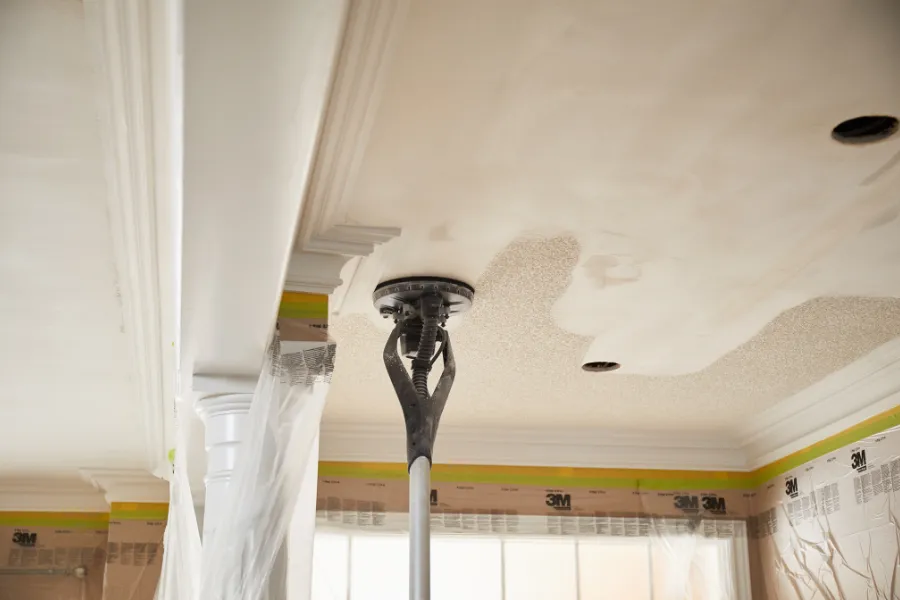
Popcorn ceiling removal has become a common home improvement project, especially for homeowners updating older properties.
Removing the texture can create a cleaner, more contemporary appearance. However, removal is not always as simple as scraping the ceiling.
The age and composition of the ceiling material matter. Some older popcorn ceilings may contain asbestos, particularly in homes built or renovated during periods when asbestos-containing building products were used.
You cannot determine asbestos content simply by looking at a ceiling.
If there is a reasonable possibility that an older ceiling contains asbestos, testing by a qualified professional can help determine the appropriate next step. Homeowners should avoid disturbing potentially hazardous materials until they understand what they are dealing with.
Popcorn Ceiling vs Textured Ceiling: Which Costs More?
There is no single price that applies to every ceiling project.
The cost can depend on the ceiling’s square footage, condition, location, labor rates, accessibility, existing paint, texture type, preparation requirements, and whether repairs are necessary.
Removing a heavily textured popcorn finish can involve several stages, potentially including preparation, removal, surface repair, sanding, priming, and painting.
Installing or repairing another textured finish may require different labor and materials.
For an accurate project budget, homeowners should evaluate the complete scope of work rather than comparing the material cost alone.
Should You Remove a Popcorn Ceiling or Keep It?
There is no universal answer.
Keeping the popcorn ceiling may make sense if the surface is in good condition, the homeowner likes its appearance, and there is no practical reason to change it.
Removal may make sense when the homeowner wants a more contemporary appearance, needs to repair the underlying ceiling, or is already planning a larger renovation.
However, the potential presence of asbestos should be considered before any older popcorn ceiling is disturbed.
Another factor is the quality of the ceiling underneath. Removing popcorn texture may reveal imperfections in the drywall or plaster that require additional finishing work.
When a Textured Ceiling Makes Sense
A textured ceiling can be useful when homeowners want to add visual character or disguise minor imperfections.
Texture can also complement certain architectural styles. A subtle finish may provide depth without dominating the room.
For renovation projects, choosing a texture that fits the home’s overall design is more important than simply selecting the most popular option.
A heavy texture in an otherwise minimalist room, for example, may create a visual contrast that the homeowner does not want.
When a Smooth Ceiling May Be Better
Although the focus is on popcorn ceiling vs textured ceiling, smooth ceilings are another important option.
A smooth finish provides a clean, simple appearance and works with many interior design styles. It is also generally easier to dust, repaint, and repair.
The disadvantage is that smooth surfaces show imperfections more readily. Poor drywall finishing, uneven joints, dents, and patches may become more noticeable under direct lighting.
That means achieving a high-quality smooth ceiling can require more preparation and finishing work.
How to Choose the Right Ceiling Finish
Homeowners can narrow down their options by considering several practical questions.
Consider the Age of the Home
An older home may require additional investigation before an existing ceiling texture is removed or disturbed.
Think About Maintenance
If easy cleaning is a major priority, a smoother finish may be preferable to a highly textured surface.
Consider the Room’s Design
The ceiling should complement the walls, flooring, lighting, trim, and furniture rather than being considered separately.
Evaluate the Existing Surface
If the current ceiling has cracks, stains, loose texture, or water damage, determine the cause before deciding on a new finish.
Consider Long-Term Plans
If you expect to sell the property or undertake a major renovation later, think about whether the selected ceiling finish will work with those plans.
Frequently Asked Questions
Is a popcorn ceiling the same as a textured ceiling?
No. A popcorn ceiling is one specific type of textured ceiling. The term “textured ceiling” includes many different finishes, such as popcorn, knockdown, orange peel, skip trowel, and swirl textures.
Are textured ceilings outdated?
Not necessarily. Some highly pronounced textures may look dated to certain homeowners, but textured ceilings remain a design option. Subtle textures can work well in traditional, rustic, or contemporary interiors.
Is popcorn ceiling harder to clean?
It can be. The raised texture provides more surfaces where dust can collect and may be more difficult to clean without damaging the material.
Is it better to remove popcorn ceilings?
That depends on the condition of the ceiling, the home’s age, the desired appearance, and the homeowner’s renovation plans. Older popcorn ceilings should be evaluated carefully before removal because some may contain asbestos.
Can you put a new texture over a popcorn ceiling?
It may be possible in some situations, but the existing surface must be stable and suitable for the proposed treatment. Simply covering an unstable or damaged texture does not solve the underlying problem.
Which ceiling texture is easiest to maintain?
Generally, smoother surfaces are easier to clean and repaint than heavily textured surfaces. Among textured options, maintenance requirements vary according to the texture’s depth and material.
Does popcorn ceiling hide imperfections?
Yes. One reason popcorn texture became popular was its ability to disguise minor imperfections in the underlying ceiling. However, significant structural, moisture, or drywall problems should not be concealed with texture.
Can popcorn ceilings contain asbestos?
Some older popcorn ceiling materials may contain asbestos. Appearance alone cannot confirm whether asbestos is present. If the ceiling is old and removal or disturbance is being considered, appropriate professional testing and guidance may be warranted.
Is knockdown texture better than popcorn?
Neither is universally better. Knockdown texture Popcorn Ceiling vs Textured Ceiling generally provides a less pronounced appearance, while popcorn has a more heavily raised surface. The better choice depends on appearance, maintenance preferences, and the condition of the ceiling.
What is the most modern alternative to a popcorn ceiling?
A smooth ceiling is one common contemporary alternative. Subtle textures such as certain knockdown finishes can also provide a more understated appearance while retaining some texture.
Conclusion
When comparing popcorn ceiling vs textured ceiling, the most important distinction is that popcorn is itself a type of textured ceiling. The real choice for many homeowners is between a heavily textured popcorn finish, a different and potentially subtler texture, or a completely smooth ceiling.
Popcorn ceilings can hide minor imperfections and have a distinctive appearance, but they may be harder to clean, repair, and update. Other textured finishes offer more variety, while smooth ceilings provide a clean look and straightforward maintenance.
Before changing an existing ceiling, consider its age, condition, construction materials, and the amount of work required to achieve the desired result. For older popcorn ceilings in particular, investigate potential asbestos concerns before sanding, scraping, drilling, or removing the material.
The best ceiling finish is ultimately the one that fits the home’s design, maintenance needs, condition, and long-term plans.

1 Comment
Pingback: Are Popcorn Ceilings Asbestos? What Homeowners Need to Know