
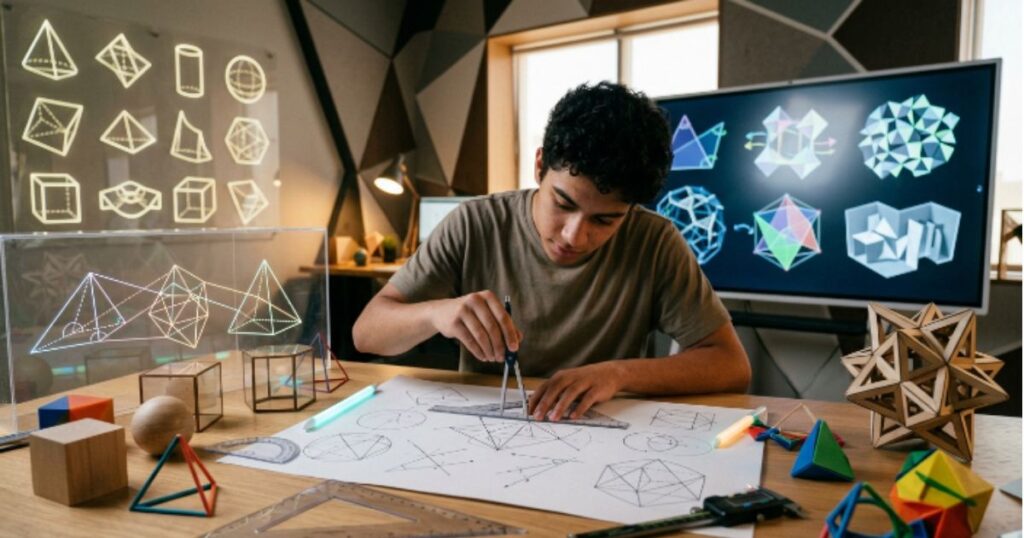
Geometry Learn V3 is one of the most important branches of mathematics, helping students understand shapes, space, measurements, angles, and logical reasoning. As educational technology continues to evolve, digital learning platforms have become an essential part of the classroom and home study experience. One platform that has gained attention among students, educators, and parents is geometry learn v3.
Whether you’re trying to improve your understanding of geometric concepts, prepare for exams, or find an interactive way to study mathematics, geometry learn v3 offers a modern approach to learning. Instead of relying solely on traditional textbooks, learners can explore concepts through interactive lessons, visual demonstrations, practice exercises, and problem-solving activities.
This guide explains everything you need to know about geometry learn v3, including its features, benefits, learning methods, practical applications, and tips for getting the best results.
What Is Geometry Learn V3?
Geometry learn v3 is a digital geometry learning platform or educational system designed to help students understand geometric principles through interactive instruction and guided practice. Rather than presenting mathematical formulas without context, it focuses on helping learners visualize concepts and develop logical reasoning skills.
Geometry often becomes easier when students can see how lines, angles, polygons, circles, and three-dimensional objects relate to one another. Interactive learning environments make this process more engaging than static diagrams found in printed materials.
The “V3” designation generally represents an updated version that introduces improved usability, enhanced learning tools, better performance, and additional educational resources compared to earlier versions.
Why Geometry Matters
Geometry is much more than memorizing formulas. It develops analytical thinking and problem-solving skills that students use throughout their academic and professional lives.
Some important areas where geometry plays a role include:
- Engineering
- Architecture
- Computer graphics
- Robotics
- Physics
- Construction
- Interior design
- Game development
- Manufacturing
- Navigation
Understanding geometry also strengthens logical reasoning, making it easier to solve complex mathematical problems.
Key Features of Geometry Learn V3
One reason geometry learn v3 stands out is its focus on making abstract mathematical concepts easier to understand through visualization and interaction.
Interactive Lessons
Interactive lessons allow students to manipulate geometric figures instead of simply observing them.
For example, learners can:
- Rotate triangles
- Resize polygons
- Measure angles
- Compare different shapes
- Observe transformations in real time
These experiences help reinforce concepts more effectively than passive reading.
Visual Learning
Geometry is highly visual by nature.
Geometry learn v3 presents concepts using diagrams, animations, color coding, and graphical demonstrations that make difficult ideas much easier to understand.
Visual learning benefits students who struggle with traditional lecture-based instruction.
Step-by-Step Problem Solving
Instead of showing only the final answer, geometry learn v3 often breaks problems into manageable steps.
Students learn:
- How to identify given information
- Which formulas apply
- Why each step is necessary
- How the solution develops logically
This builds confidence while reducing frustration.
Practice Exercises
Practice remains one of the most effective ways to master mathematics.
Geometry learn v3 includes exercises covering topics such as:
- Angles
- Triangles
- Quadrilaterals
- Circles
- Coordinate geometry
- Surface area
- Volume
- Similarity
- Congruence
- Transformations
Regular practice helps reinforce classroom learning.
Progress Tracking
Many educational platforms include progress monitoring so learners can identify strengths and weaknesses.
Progress tracking may include:
- Completed lessons
- Quiz scores
- Accuracy percentages
- Improvement over time
- Topic mastery
These insights help students focus their study efforts efficiently.
Topics Covered in Geometry Learn V3
A comprehensive geometry platform should address both foundational and advanced topics.
Points, Lines, and Planes
Students begin by learning the basic building blocks of geometry.
These include:
- Points
- Line segments
- Rays
- Parallel lines
- Perpendicular lines
- Planes
Understanding these concepts creates the foundation for everything that follows.
Angles
Geometry learn v3 typically provides extensive coverage of angle relationships.
Topics include:
- Acute angles
- Obtuse angles
- Right angles
- Straight angles
- Vertical angles
- Complementary angles
- Supplementary angles
Interactive diagrams make these relationships easier to understand.
Triangles
Triangles represent one of the most important units in geometry.
Students study:
- Types of triangles
- Interior angles
- Exterior angles
- Triangle inequality theorem
- Pythagorean theorem
- Similar triangles
- Congruent triangles
Problem-solving exercises help reinforce these concepts.
Quadrilaterals
Different quadrilaterals have unique properties.
Geometry learn v3 explains:
- Squares
- Rectangles
- Rhombuses
- Parallelograms
- Trapezoids
- Kites
Students learn how side lengths, angles, and diagonals relate.
Circles
Circle geometry often challenges learners because it introduces several new concepts simultaneously.
Lessons typically include:
- Radius
- Diameter
- Circumference
- Chords
- Tangents
- Secants
- Arcs
- Central angles
- Inscribed angles
Visual demonstrations simplify these relationships.
Coordinate Geometry
Coordinate geometry combines algebra and geometry.
Students explore:
- Cartesian coordinates
- Distance formula
- Midpoint formula
- Slope
- Equations of lines
- Graphing geometric figures
Interactive graphs make coordinate concepts easier to grasp.
Transformations
Geometry learn v3 often includes transformation lessons covering:
- Translation
- Rotation
- Reflection
- Dilation
Animation allows students to watch shapes transform while maintaining important geometric properties.
Three-Dimensional Geometry
Advanced learners study solid figures including:
- Cubes
- Cylinders
- Cones
- Spheres
- Pyramids
- Prisms
Lessons focus on:
- Surface area
- Volume
- Cross sections
- Spatial reasoning
Benefits of Using Geometry Learn V3
Students learn in different ways. Interactive educational platforms help accommodate various learning styles.
Better Concept Visualization
Geometry depends heavily on spatial understanding.
Instead of imagining figures mentally, learners can manipulate shapes directly, making difficult concepts much easier to understand.
Self-Paced Learning
Every student progresses differently.
Geometry learn v3 allows learners to revisit lessons, repeat exercises, and study at their own pace without classroom pressure.
Increased Engagement
Interactive activities naturally keep students more engaged than traditional lectures.
Gamified quizzes, animations, and visual demonstrations help maintain motivation during study sessions.
Immediate Feedback
Receiving instant feedback helps students correct mistakes before they become habits.
Instead of waiting for graded assignments, learners understand errors immediately.
Improved Exam Preparation
Consistent practice improves performance on school exams and standardized mathematics tests.
Review modules help students revisit previously learned topics before examinations.
Real-World Applications of Geometry
Students often wonder why geometry matters beyond school.
The truth is geometry influences countless aspects of everyday life.
Architecture
Architects rely on geometry when designing buildings, bridges, homes, and public spaces.
Precise measurements ensure structures remain safe and functional.
Engineering
Engineers use geometry while designing machinery, vehicles, roads, electrical systems, and manufacturing equipment.
Computer Graphics
Modern video games, movies, and animation depend heavily on geometric modeling.
Three-dimensional objects are created using geometric principles.
Navigation
GPS systems calculate routes using geometric algorithms involving coordinates and distances.
Interior Design
Furniture placement, room layouts, flooring patterns, and lighting plans all involve geometric calculations.
Sports
Many sports incorporate geometry.
Examples include:
- Calculating shooting angles in basketball
- Determining ball trajectories in soccer
- Designing athletic fields
- Measuring performance distances
Tips for Learning Geometry Effectively
Using geometry learn v3 becomes even more effective when combined with good study habits.
Understand Before Memorizing
Rather than memorizing formulas immediately, first understand what they represent and why they work.
Conceptual understanding improves long-term retention.
Draw Diagrams
Even simple sketches make problems easier to visualize.
Many geometry questions become clearer after drawing the given information.
Practice Consistently
Short daily practice sessions usually produce better results than occasional long study sessions.
Consistency strengthens mathematical confidence.
Review Mistakes
Incorrect answers often provide valuable learning opportunities.
Study why an answer was wrong before moving on.
Connect Geometry to Everyday Life
Observe geometry in buildings, roads, artwork, sports, furniture, and nature.
Recognizing real-world examples makes abstract ideas more meaningful.
Who Can Benefit from Geometry Learn V3?
Geometry learn v3 serves a wide variety of learners.
Middle School Students
Students building their mathematical foundations can use interactive lessons to understand basic geometric concepts.
High School Students
High school learners preparing for exams benefit from comprehensive lessons and extensive practice exercises.
Teachers
Educators can incorporate visual demonstrations into classroom instruction to improve student engagement.
Parents
Parents helping children with homework can use structured explanations to support learning at home.
Independent Learners
Anyone interested in improving mathematical skills can study geometry independently using organized learning materials.
Common Challenges Students Face
Geometry presents several unique challenges.
Understanding these difficulties helps learners overcome them more efficiently.
Visualizing Shapes
Many students struggle to mentally picture three-dimensional figures.
Interactive graphics significantly improve spatial reasoning.
Remembering Formulas
Instead of memorizing dozens of formulas independently, students should understand how formulas are derived and when each applies.
Multi-Step Problems
Geometry problems often require several connected steps.
Breaking problems into smaller parts reduces confusion.
Proof Writing
Geometric proofs require logical thinking rather than simple calculation.
Regular practice helps students become comfortable with structured reasoning.
Best Practices for Success with Geometry Learn V3
To maximize learning outcomes:
- Complete lessons in sequence.
- Practice every topic before advancing.
- Review incorrect answers carefully.
- Revisit weak areas regularly.
- Combine digital learning with handwritten practice.
- Apply concepts to real-world examples whenever possible.
These habits strengthen both understanding and long-term memory.
Frequently Asked Questions
What is geometry learn v3?
Geometry learn v3 is an interactive educational platform designed to help learners understand geometry through visual instruction, guided practice, and structured problem-solving activities.
Is geometry learn v3 suitable for beginners?
Yes. Beginners can start with foundational concepts like points, lines, angles, and basic shapes before progressing to more advanced topics.
Can geometry learn v3 help with school exams?
Yes. The platform supports exam preparation by providing explanations, practice exercises, quizzes, and opportunities for repeated review.
Does geometry learn v3 cover advanced geometry?
Many versions include advanced topics such as coordinate geometry, transformations, circles, proofs, and three-dimensional geometry.
Why is interactive geometry learning effective?
Interactive learning helps students visualize abstract concepts, receive immediate feedback, and actively participate in the learning process, leading to stronger understanding and better retention.
How often should students practice geometry?
Regular practice is ideal. Even 20 to 30 minutes of focused study several times a week can significantly improve understanding and confidence.
Conclusion
Geometry remains one of the most valuable areas of mathematics because it develops logical reasoning, spatial awareness, and analytical thinking that extend far beyond the classroom. Geometry learn v3 offers a modern, engaging way to study these concepts through interactive lessons, visual demonstrations, guided practice, and structured problem-solving.
Whether you are a student preparing for exams, a teacher looking for effective instructional support, or an independent learner strengthening mathematical skills, geometry learn v3 provides an organized framework for mastering geometry. By combining consistent practice with conceptual understanding and real-world applications, learners can build confidence, improve academic performance, and develop problem-solving abilities that remain valuable throughout education and future careers.
